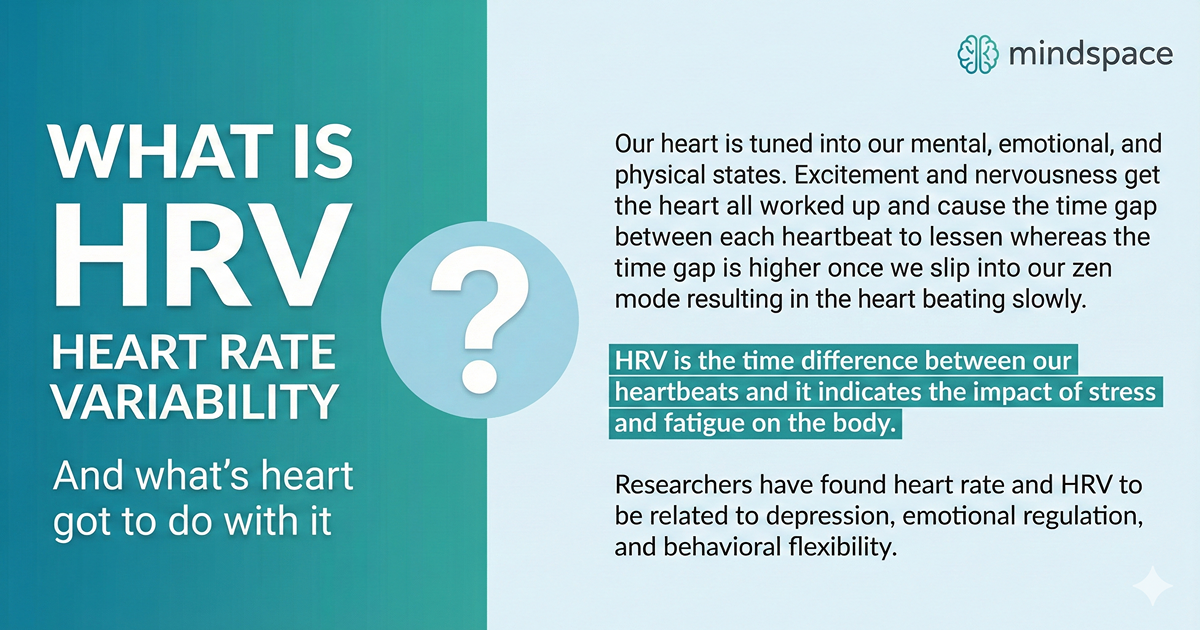
Our heart is tuned in to our mental, emotional, and physical states. Excitement and nervousness get the heart all worked up and causes the time variation between each heartbeat to be less whereas the time variation is higher once we slip into our zen mode resulting in the heart to beat slowly.
What is Heart Rate and Heart Rate Variability (HRV)?
Heart rate is the number of heart beats per minute and Heart Rate Variability (HRV) is the subtle variation in a series of beat-to-beat measures of the heart. HRV indicates the impact of stress and fatigue on the body. In other words, the more relaxed and less stressed you are, the more variability in the time between each of your heartbeats.
Note: Heart rate and heart rate variability are controlled by the autonomic nervous system (ANS). The ANS consists of the sympathetic nervous system (which increases heart rate under stress) and the parasympathetic nervous system (which returns it to normal during relaxation).How is it related to mental health?
Researchers have found heart rate and HRV to be related with depression, emotional regulation, and behavioral flexibility. It was found that those with depression had both a higher heart rate and a lower heart rate variation.
Depressed patients were found to have a heart rate which was roughly 10 to 15 beats per minute higher than in controls. The heart rates of the participants with depression stayed elevated during the night, when it usually reduces. Even people who are physically healthy but depressed have reduced heart rate variability. Additionally, when heart rate data was tested in an artificial intelligence program, the software was able to correctly identify participants with and without depression (Schiweck et al. 2021).
What is the reliability of diagnosing depression based on HRV measurements?
Heart rate and HRV are not absolute measures for diagnosing someone with depression. However, it is one of the biomarkers which have been associated with depression. Thus, improving HRV is expected to aid in the treatment of depression.
Even though there are modern devices to measure heart rate and HRV, the gold standard for diagnosis purposes remains the analysis of ECG data by a doctor.
Heart rate and HRV are important physiological markers for overall health and the body-mind connection. It indicates how well the body can prevent and recover from distressing states. Hence, take good care of your heart.
REFERENCES: