If you're an HSC student searching for clear explanations of inbreeding depression, you've come to the right place. This concept appears in your genetics syllabus, and understanding it well can help you ace your exams—and appreciate its real-world significance.
At Mindspace, we believe education should connect textbook concepts to real life. So we'll not only explain the biology clearly, but also show you why this topic matters for human health and society.
Let's dive in!
What Is Inbreeding?
Definition
Inbreeding is the mating of closely related individuals—organisms that share common ancestors.Examples:- Self-fertilization (plants)- Brother-sister mating (animals)- First-cousin marriages (humans)- Parent-offspring matingMeasuring Inbreeding
Coefficient of Inbreeding (F):The probability that two alleles at any locus are identical by descent (inherited from the same ancestor).| Relationship | Coefficient (F) |
|---|---|
| Self-fertilization | 0.50 |
| Parent-offspring | 0.25 |
| Full siblings | 0.25 |
| Half siblings | 0.125 |
| First cousins | 0.0625 |
| Second cousins | 0.0156 |
| Unrelated | ~0 |
What Is Inbreeding Depression?
Definition
Inbreeding depression is the reduced biological fitness (survival and reproduction) observed in a population after inbreeding. It occurs because inbreeding increases homozygosity, which can expose harmful recessive alleles.Key Term Breakdown
| Term | Meaning |
|---|---|
| Homozygosity | Having two identical alleles at a locus (AA or aa) |
| Heterozygosity | Having two different alleles at a locus (Aa) |
| Recessive allele | Allele that only shows effect when homozygous |
| Fitness | Ability to survive and reproduce |
| Depression | Reduction or decline |
The Genetic Mechanism: Why Does Inbreeding Cause Problems?
The Role of Harmful Recessive Alleles
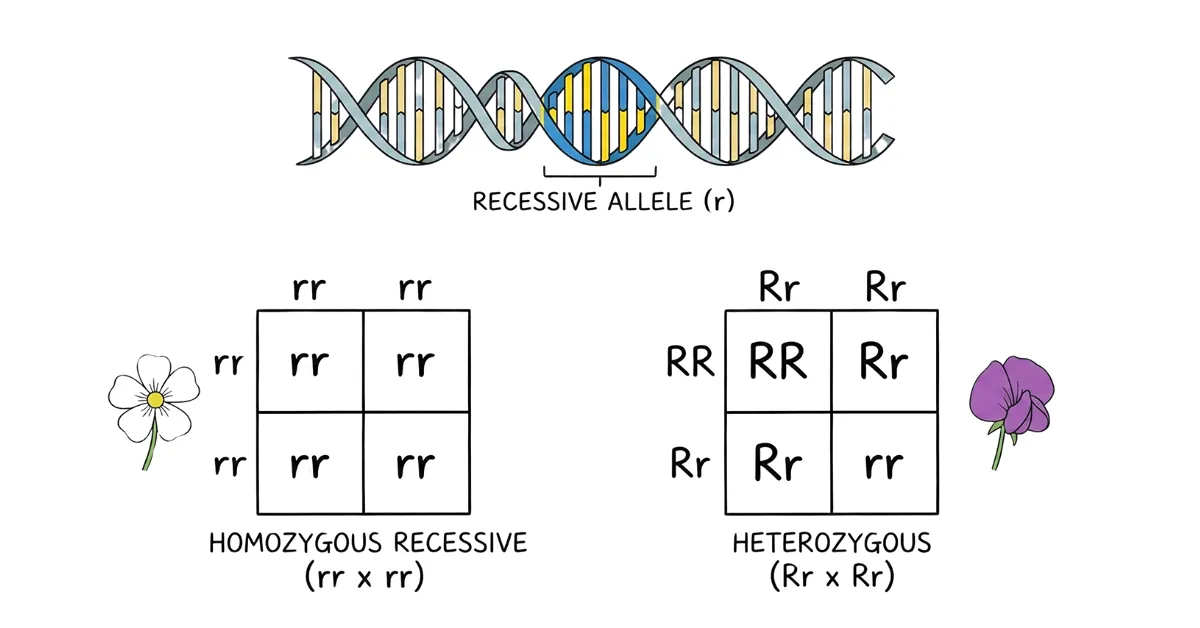
Every organism carries some deleterious (harmful) recessive alleles. These are mutations that:- Reduce fitness- Are usually rare in the population- Don't cause problems when heterozygous (masked by dominant allele)- Only cause harm when homozygous
Example:Normal: Aa × Aa (unrelated parents, different recessive alleles)- AA: Normal- Aa: Normal (carrier)- aa: Rare (needs same recessive from both parents)Inbred: Aa × Aa (related parents, same recessive allele)- AA: Normal- Aa: Normal (carrier)- aa: More common (both parents carry the SAME allele)
Increased Homozygosity
With each generation of inbreeding:- Heterozygosity decreases- Homozygosity increases- Harmful recessives are more likely to be expressedMathematical Representation
After n generations of inbreeding with coefficient F:
Heterozygosity (Hₙ) = H₀ × (1 - F)ⁿWhere:- H₀ = Initial heterozygosity- Hₙ = Heterozygosity after n generations- F = Inbreeding coefficient
This shows that heterozygosity declines exponentially with inbreeding.
Effects of Inbreeding Depression
Observable Effects
| Effect | Explanation |
|---|---|
| Reduced survival | More offspring die before reproducing |
| Lower fertility | Fewer offspring produced |
| Slower growth | Developmental problems |
| Increased disease susceptibility | Immune system weakened |
| Smaller body size | Growth affected |
| Developmental abnormalities | Structural defects |
| Reduced lifespan | Shorter life expectancy |
Examples in Different Organisms
Plants:- Reduced seed set- Smaller plants- Lower crop yield- Increased disease susceptibilityAnimals:- Lower survival rates- Reduced litter sizes- Weaker immune systems- Behavioral abnormalities (in some species)Humans:- Higher infant mortality- Increased genetic disorders- Lower IQ (on average)- Reduced immune functionThe Opposite: Heterosis (Hybrid Vigor)
What Is Heterosis?
Heterosis (also called hybrid vigor or outbreeding enhancement) is the opposite of inbreeding depression—the improved fitness observed when genetically different parents mate.Why Heterosis Occurs
Possible Mechanisms:Agricultural Applications
Heterosis is widely used in agriculture:
| Application | Example |
|---|---|
| Corn (maize) | Hybrid varieties yield 20-50% more |
| Rice | Hybrid rice in Bangladesh/Asia |
| Cattle | Crossbreeding for improved meat/milk |
| Poultry | Hybrid chickens for egg/meat production |
| Vegetables | Hybrid tomatoes, peppers, etc. |
Inbreeding Depression vs. Heterosis: Summary Table
| Feature | Inbreeding Depression | Heterosis |
|---|---|---|
| Cause | Mating of relatives | Mating of genetically different individuals |
| Effect on homozygosity | Increases | Decreases |
| Effect on heterozygosity | Decreases | Increases |
| Effect on fitness | Decreases | Increases |
| Mechanism | Expression of harmful recessives | Masking of harmful recessives / overdominance |
| Agricultural use | Avoided | Exploited |
Exam-Focused: Important Points for HSC
Key Definitions to Memorize
Common Exam Questions
Q: What is inbreeding depression?A: Inbreeding depression is the reduction in biological fitness (survival and reproduction) observed in a population following inbreeding. It occurs because inbreeding increases homozygosity, which increases the expression of deleterious recessive alleles.Q: Explain the genetic basis of inbreeding depression.A: All organisms carry some harmful recessive alleles. In heterozygous individuals (Aa), these are masked by dominant alleles. When closely related individuals mate, they often share the same recessive alleles inherited from common ancestors. Their offspring have a higher probability of being homozygous for these harmful recessives (aa), causing reduced fitness.
Q: What is heterosis and how does it differ from inbreeding depression?A: Heterosis (hybrid vigor) is the increased fitness observed when genetically different individuals mate. It is the opposite of inbreeding depression. While inbreeding increases homozygosity and exposes harmful recessives, outbreeding increases heterozygosity and masks harmful recessives, improving fitness.
Q: Why is heterosis important in agriculture?A: Heterosis is exploited in agriculture to produce high-yielding crop varieties and livestock. F1 hybrid varieties (crosses between different inbred lines) show increased growth, yield, and disease resistance compared to their parent lines. This has led to significant increases in food production.
Diagram Practice
Draw and label:Beyond the Syllabus: Real-World Implications
Why This Matters for Human Health
Now that you understand the biology, let's connect it to the real world.
Consanguineous Marriage (Marriage Between Relatives):- Practiced in many cultures worldwide, including parts of Bangladesh- Most commonly first-cousin marriages- Genetic implications follow the same principles as inbreeding depression
Health Outcomes in Consanguineous Marriages:| Outcome | Approximate Risk Increase |
|---|---|
| Congenital abnormalities | 2x higher |
| Infant mortality | 1.5-2x higher |
| Recessive genetic disorders | 5-8x higher |
| Cognitive impairment | Variable increase |
Public Health Perspective
Key Points:- The biology you're learning has direct implications for human health- Genetic counseling can help families understand risks- Understanding genetics helps make informed decisions- This is a public health issue, not a moral judgmentGenetic Counseling in Bangladesh
What it involves:- Family history assessment- Risk calculation- Information provision- Decision supportWhere available:- Major hospitals in Dhaka- Some private genetics services- Limited but growing availabilityMindspace's Perspective: Connecting Biology to Mental Health
At Mindspace, we focus on mental health—but understanding genetics helps us appreciate:
Why This Relates to Mental Health
Our Role
We provide:- Support for families navigating difficult health decisions- Counseling for those affected by genetic conditions- Mental health care for caregivers- Non-judgmental, evidence-based information
Study Tips for This Topic
For Remembering Key Concepts
Mnemonic for Inbreeding Effects:"INBRED HARMS"- Increased homozygosity- Narrowed gene pool- Bad (harmful) recessives expressed- Reduced fitness- Early death more common- Disease susceptibility up- Heterozygosity drops- Abnormalities increase- Reproduction reduced- Masks removed from recessives- Survival decreased
For Exam Success
Practice Questions
Multiple Choice
1. Inbreeding depression occurs because:a) Dominant alleles become more commonb) Heterozygosity increasesc) Homozygosity increases, exposing harmful recessivesd) Beneficial mutations accumulateAnswer: c2. The coefficient of inbreeding for first cousins is approximately:a) 0.50b) 0.25c) 0.0625d) 0.0156Answer: c (6.25% or 1/16)
3. Heterosis is maximized in:a) Self-fertilizing plantsb) Brother-sister matingsc) F1 hybrids from genetically different parentsd) Highly inbred populationsAnswer: c
Short Answer
4. Explain why breeders create inbred lines before crossing them to produce hybrid crops.Answer: Breeders first create inbred lines through several generations of self-fertilization or sibling mating to make them genetically uniform (homozygous at most loci). When two different inbred lines are crossed, the F1 offspring are highly heterozygous, exhibiting maximum heterosis (hybrid vigor) with improved yield, growth, and disease resistance. The inbred parents allow for predictable, uniform hybrid offspring.5. A population has been isolated and inbreeding for several generations. Predict the effect on the population's fitness and explain why.Answer: The population's fitness will likely decline (inbreeding depression). After several generations of inbreeding, homozygosity increases significantly. This exposes harmful recessive alleles that were previously masked in heterozygotes. As these deleterious recessives are expressed, individuals will show reduced survival, lower fertility, increased disease susceptibility, and developmental abnormalities.
Conclusion
Inbreeding depression and heterosis are two sides of the same genetic coin:- Inbreeding → Homozygosity ↑ → Harmful recessives expressed → Fitness ↓- Outbreeding → Heterozygosity ↑ → Harmful recessives masked → Fitness ↑
Understanding these concepts helps you:- Excel in your HSC biology exams- Understand real-world applications in agriculture- Appreciate the public health implications for human populations- Make connections between textbook knowledge and life
Good luck with your studies! And remember: the biology you're learning isn't just for exams—it helps you understand the world.Quick Reference Summary
| Term | Definition |
|---|---|
| Inbreeding | Mating between relatives |
| Inbreeding depression | Reduced fitness from inbreeding |
| Heterosis | Increased fitness from outbreeding |
| Homozygosity | Two identical alleles |
| Heterozygosity | Two different alleles |
| Coefficient of inbreeding (F) | Probability of identity by descent |
| Deleterious recessive | Harmful allele masked in heterozygotes |
Need help understanding how genetics connects to mental health? Mindspace is here to support students and families navigating complex health topics.Learn well. Think critically. Stay curious.