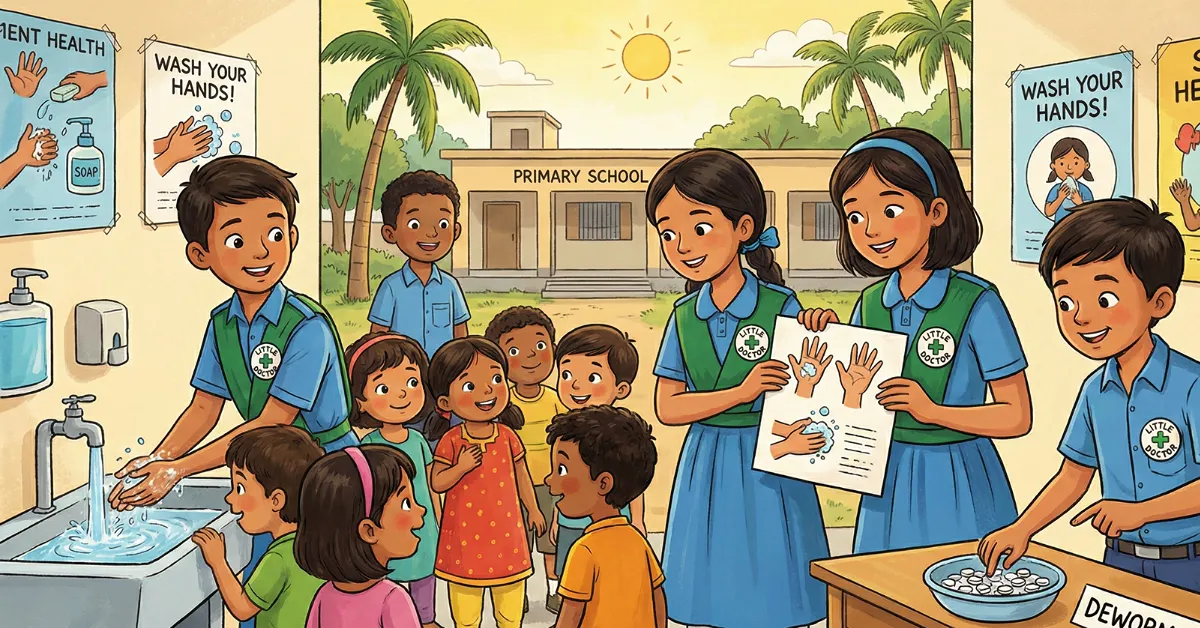
What if the key to better public health isn't more doctors—but more children talking to children?
Across Bangladesh, a remarkable program is proving this idea works. The "Little Doctors" initiative trains schoolchildren to become health ambassadors in their communities, spreading knowledge about deworming, hygiene, nutrition, and disease prevention to their peers and families.
At Mindspace, we see the genius in this approach: not only does peer-to-peer education work better, but the act of being a health leader transforms children's confidence, self-esteem, and mental wellbeing.
Let's explore this innovative program and what it teaches us about empowering young people.
What Is the Little Doctors Program?
Overview
The Little Doctors (or "Chhoto Daktar" in Bengali) program is a school-based health initiative that:
- Selects students from schools to receive health training- Educates them on key health topics- Empowers them to share knowledge with classmates, families, and communities- Creates a network of young health ambassadors
How It Works
| Step | Description |
|---|---|
| Selection | Students (often grades 4-8) selected based on interest, academics, leadership |
| Training | Multi-day training on health topics by health professionals |
| Materials | Provided with badges, certificates, educational materials |
| Action | Students conduct health education activities in school and community |
| Support | Ongoing guidance from teachers and health workers |
| Recognition | Celebrated for their contributions |
What Little Doctors Learn
Core Topics:- Personal hygiene (handwashing, dental care)- Nutrition and balanced diet- Deworming importance and timing- Safe water and sanitation- Disease prevention (diarrhea, dengue, etc.)- First aid basics- Importance of vaccination- Menstrual hygiene (for older students)The Power of Peer Education
Why Children Teaching Children Works
1. Trust and RelatabilityChildren often trust peers more than adults for certain information:- Same language and communication style- Shared experiences and concerns- Less intimidating than authority figures- More believable ("If Rahima says it's important, maybe it is")
2. Social InfluenceChildren influence each other's behavior:- Peer pressure can work positively- Modeling behavior matters- Social norms shift when peers adopt new practices- "Cool" factor when health behaviors become accepted
3. Repetition and ReinforcementLearning happens through repetition:- Little Doctors reinforce messages daily- Unlike a one-time health talk- Creates continuous learning environment- Questions can be asked anytime
4. Reach ExtensionChildren reach places professionals can't:- Every home has children- Information spreads through families- Messages reach parents through children- Community coverage expands dramatically
Evidence of Effectiveness
Research on peer health education shows:
| Outcome | Evidence |
|---|---|
| Knowledge increase | Students show significant gains in health knowledge |
| Behavior change | Handwashing, hygiene practices improve |
| Community reach | Families report receiving health information from children |
| Deworming uptake | Higher participation where Little Doctors are active |
| Sustainability | Programs can continue with minimal external support |
The Mental Health Benefits: Empowerment and Confidence
For Little Doctors Themselves
Being chosen and trained as a Little Doctor:| Benefit | How It Manifests |
|---|---|
| Self-esteem boost | "I am important, I can make a difference" |
| Confidence | Public speaking, leadership skills |
| Purpose and meaning | Contributing to community wellbeing |
| Social status | Respect from peers, teachers, family |
| Skill development | Communication, teaching, organization |
| Future orientation | Interest in health careers, service |
| Agency | Feeling empowered to create change |
For the School Community
When health education comes from peers:- Less stigma around health topics- More open discussions- Normalization of health-seeking behavior- Reduced bullying related to hygiene- More supportive environment
For Families
When children bring health knowledge home:- Parents learn from children (role reversal can be empowering)- Family discussions about health- Improved household practices- Children valued for their knowledge- Strengthened family communication
Deworming: A Case Study in Little Doctors' Impact
The Deworming Challenge
Bangladesh has high rates of intestinal worm infections:- Affects cognitive development- Causes anemia and malnutrition- Reduces school attendance and performance- Treatment is simple and cheap—but uptake requires awareness
How Little Doctors Help
Before National Deworming Day:- Little Doctors remind classmates- Inform families about dates and importance- Address myths and fears about medication- Create excitement rather than resistanceOn Deworming Day:- Model taking medication- Encourage hesitant students- Answer questions from peers- Report to teachers about participationAfter Deworming:- Reinforce hygiene practices- Monitor for any concerns- Continue prevention educationResults
Schools with active Little Doctors programs typically show:- Higher deworming participation rates- Better understanding of why deworming matters- Improved hygiene behaviors- Greater health awareness overall
Implementing the Little Doctors Model
For Schools
Getting Started:| Practice | Why It Matters |
|---|---|
| Inclusive selection | All children can contribute |
| Interactive training | Engaging methods work better |
| Visible recognition | Badges, certificates motivate |
| Regular activities | Ongoing engagement, not one-time |
| Adult support | Guidance without taking over |
| Student voice | Let them shape activities |
| Documentation | Track impact and learnings |
For Health Organizations
Supporting Little Doctors Programs:- Provide training resources- Supply educational materials- Offer recognition and incentives- Monitor and evaluate programs- Share learnings across schools- Advocate for scaling successful models
For Parents
Supporting Your Little Doctor:- Encourage their participation- Listen to what they learn- Help them practice presentations- Adopt healthy behaviors at home- Celebrate their role- Model being a health learner too
Expanding the Model: Beyond Physical Health
Little Doctors and Mental Health
Could the model work for mental health?Opportunities:- Peer support for emotional challenges- Reducing mental health stigma- Recognizing when friends need help- Promoting wellbeing practices- Creating supportive school environmentsConsiderations:- Appropriate topics for age level- Safeguarding and boundaries- Not replacing professional help- Training on sensitive issues- Support systems for Little Doctors themselvesWhat Little Mental Health Ambassadors Could Do
| Activity | Description |
|---|---|
| Kindness campaigns | Promoting positive peer relationships |
| Stress awareness | Age-appropriate information about stress |
| Help-seeking promotion | Normalizing talking to adults about problems |
| Anti-bullying | Peer intervention and reporting |
| Mindfulness activities | Simple practices for the classroom |
| Inclusion efforts | Welcoming marginalized students |
Mindspace's Vision
At Mindspace, we see potential for:
- Training Little Doctors in basic mental health awareness- Creating peer support networks in schools- Reducing stigma through youth voices- Early identification through peer awareness- Building resilient school communities
Success Stories
Rahima's Story (Name changed)
"Before becoming a Little Doctor, I was shy and didn't speak in class. Now I teach younger students about handwashing. My teacher says I'm a leader. My mother is so proud that I taught her things about health she didn't know. I want to be a doctor when I grow up—a real one!"A Teacher's Perspective
"The children take it so seriously. They wear their badges proudly and remind each other about hygiene. The health days have become something they look forward to. And I see quieter children coming out of their shells when given this responsibility."A Parent's View
"My daughter came home explaining about worms and deworming. She told me we all need to take the medicine. I listened to her! If she hadn't explained so clearly, I might have been afraid of the medicine. Now our whole family takes it."Challenges and Solutions
Common Challenges
| Challenge | Solution |
|---|---|
| Teacher workload | Integrate into existing activities; minimal extra work |
| Sustainability | Build into school culture; train new cohorts annually |
| Quality of training | Standardized materials; regular refreshers |
| Student turnover | Annual selection process; graduating classes train next |
| Measuring impact | Simple tracking tools; periodic surveys |
| Gender balance | Intentional inclusion of both genders |
| Reaching out-of-school children | Community outreach components |
Lessons Learned
- Start small, build momentum- Recognize and celebrate contributions- Support without controlling — Let students lead- Connect to existing programs — Deworming week, etc.- Build in reflection — Help students process their experience- Include all abilities — Every child can contribute
The Bigger Picture: Children as Change Agents
Why This Matters Beyond Health
The Little Doctors model demonstrates that:
Applications Beyond Health
This model inspires similar approaches in:- Environmental awareness (Little Environmentalists)- Digital literacy (Little Tech Ambassadors)- Road safety (Little Traffic Helpers)- Reading promotion (Little Librarians)- Community service (Little Citizens)
Mindspace's Role
At Mindspace, we support children's wellbeing in multiple ways:
Direct Services:
- Child and adolescent mental health services- School-based mental health programs- Training for teachers on student wellbeing- Family support and parenting guidanceAdvocacy:
- Promoting whole-child approaches to health- Supporting programs that empower young people- Reducing stigma around mental health- Building evidence for effective interventionsVision:
- Every school with mental health awareness- Students supporting students- Teachers equipped to recognize and respond- Communities where children thriveTake Action
For Schools
Consider starting a Little Doctors program:- Contact local health services for support- Designate a champion teacher- Start with deworming or handwashing focus- Expand as capacity grows
For Parents
Support health education at home:- Ask children what they learned in health activities- Follow through on health practices- Value your child's health knowledge- Encourage their participation in school programs
For Organizations
Partner with schools:- Offer training and materials- Provide recognition for student ambassadors- Document and share successes- Advocate for scaling effective models
For Students
Become a health leader:- Volunteer for health ambassador roles- Share what you learn with family- Support classmates' health- Be proud of making a difference
Frequently Asked Questions
What age are Little Doctors typically?
Usually grades 4-8 (ages 9-14), though programs vary. Younger students can participate in simpler activities.Do Little Doctors replace health professionals?
No. They complement professional health services by extending reach and reinforcing messages. They are ambassadors, not medical providers.How can my child become a Little Doctor?
Ask your child's school if they have such a program. If not, suggest starting one in partnership with local health services.Can this model help with mental health too?
Yes, with appropriate adaptation. Age-appropriate mental health awareness, peer support, and stigma reduction can be incorporated.The Little Doctors program shows what's possible when we trust children with responsibility and give them tools to make a difference. At Mindspace, we believe in empowering young people—for their health and for their mental wellbeing.Small doctors, big impact. Empowered children, healthier communities.