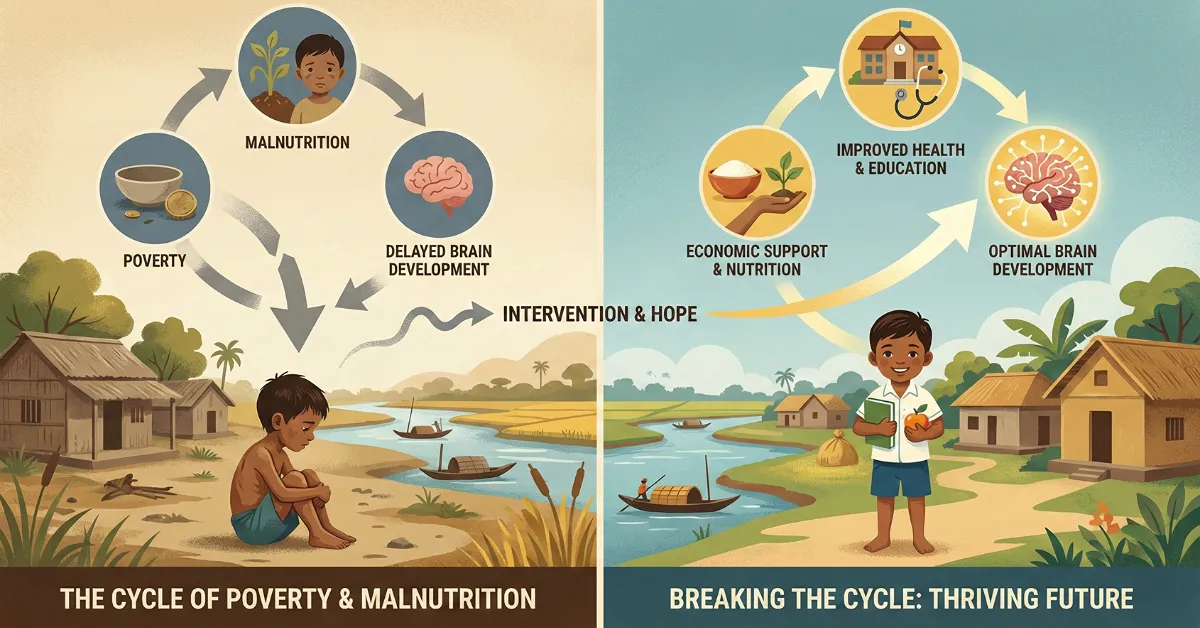
When we talk about child mental health, we often focus on individual factors—trauma, family dynamics, or neurodevelopmental conditions. But in Bangladesh, where 36% of children under five are stunted and millions live in poverty, we cannot separate mental health from its socioeconomic foundations.
The evidence is clear: poverty and malnutrition don't just affect children's bodies—they fundamentally shape their brains, emotions, and life trajectories.
At Mindspace, we believe addressing mental health requires understanding its root causes. This article examines the complex relationship between economic deprivation, nutritional deficiency, and child mental health in Bangladesh—with implications for policy, programming, and care.
The Bangladesh Context: A Nation of Progress and Persistent Challenges
Economic Progress
Bangladesh has made remarkable strides:- GDP growth averaging 6-7% annually (pre-pandemic)- Poverty reduction from 44% (1991) to under 20% (2019)- Impressive gains in education, health, and gender equality- Recognition as a development success story
Persistent Realities
Yet challenges remain:- Approximately 30 million people still live below the poverty line- Urban slums growing with rural-urban migration- Income inequality widening- Climate vulnerability threatening livelihoods- Malnutrition rates stubbornly high despite progress
Child Malnutrition Statistics
| Indicator | Rate (Bangladesh) | Global Average |
|---|---|---|
| Stunting (low height-for-age) | 28-36% | 22% |
| Wasting (low weight-for-height) | 10-14% | 7% |
| Underweight (low weight-for-age) | 22-28% | 14% |
| Micronutrient deficiency | 40-60% | Varies |
Understanding the Pathways: How Poverty Affects Mental Health
The Biopsychosocial Model
Poverty affects child mental health through multiple interconnected pathways:
POVERTY ↓├── Biological: Malnutrition, disease, toxin exposure├── Psychological: Stress, trauma, limited stimulation└── Social: Family stress, reduced opportunities, stigma ↓IMPAIRED DEVELOPMENT & MENTAL HEALTHPathway 1: Nutritional Deficiency and Brain Development
The First 1,000 DaysThe period from conception to age 2 is critical for brain development. During this window:
- Brain grows to 80% of adult size- Synaptic connections form rapidly- Nutritional needs are exceptionally high- Damage is often irreversible
How Malnutrition Harms the Brain:| Deficiency | Brain Impact |
|---|---|
| Protein-energy | Reduced brain growth, fewer neurons |
| Iron | Impaired myelination, neurotransmitter deficits |
| Iodine | Severe cognitive impairment, cretinism |
| Zinc | Impaired neurogenesis, memory problems |
| Vitamin A | Vision problems affecting learning |
| Omega-3 fatty acids | Reduced brain structure, signaling issues |
Research consistently shows stunted children have:- Lower IQ scores (5-11 points on average)- Poorer school performance- Reduced attention and memory- Delayed language development- Lower adult earnings (20-30% reduction)
Pathway 2: Chronic Stress and Toxic Stress
The Stress Response SystemChildren in poverty experience chronic stress from:- Food insecurity- Housing instability- Parental stress and mental illness- Exposure to violence- Unpredictable environments
Toxic Stress Defined:When stress is prolonged and lacks buffering relationships, it becomes "toxic":
- Elevated cortisol damages developing brain- Hippocampus (memory center) particularly vulnerable- Prefrontal cortex (executive function) affected- Amygdala (fear center) becomes overactive
Long-term Effects:- Heightened anxiety and fear responses- Difficulty regulating emotions- Attention and memory problems- Increased risk of mental disorders- Changes in gene expression (epigenetics)Pathway 3: Reduced Cognitive Stimulation
The Stimulation GapChildren in poverty often experience:- Fewer books and learning materials- Less verbal interaction (parents working long hours)- Limited enrichment activities- Overcrowded, chaotic environments- Fewer learning opportunities
Impact on Development:- Reduced vocabulary and language skills- Lower school readiness- Fewer neural connections- Delayed cognitive milestonesPathway 4: Parental Mental Health
The Intergenerational TransmissionPoverty significantly increases parental mental illness:- Maternal depression rates 2-3x higher in poverty- Paternal stress and substance abuse elevated- Parenting quality often affected
How This Affects Children:- Reduced responsiveness and warmth- Inconsistent caregiving- Modeling of maladaptive coping- Attachment disruptions- Increased household conflictPathway 5: Environmental Hazards
Physical Environment Risks:| Hazard | Prevalence in Poverty | Mental Health Impact |
|---|---|---|
| Lead exposure | Higher | Cognitive damage, behavior problems |
| Air pollution | Higher | Neuroinflammation, cognitive effects |
| Water contamination | Higher | Disease, arsenic neurotoxicity |
| Noise pollution | Higher | Stress, learning interference |
| Crowding | Higher | Stress, sleep disruption |
The Cycle of Poverty and Mental Health
How the Cycle Perpetuates
Poverty → Malnutrition + Stress + Limited Opportunities ↓ Impaired Cognitive and Emotional Development ↓ Lower Educational Achievement ↓ Reduced Employment Opportunities ↓ Continued Poverty → Next GenerationBreaking the Cycle
Evidence shows interventions can interrupt this cycle at multiple points:
1. Early Childhood (Highest Impact)- Nutrition supplementation- Early stimulation programs- Parenting support- Quality childcare2. School Age- Nutrition programs (school feeding)- Mental health services in schools- Quality education- Social-emotional learning3. Adolescence and Beyond- Vocational training- Mental health support- Cash transfers- Opportunity creationSpecific Vulnerabilities in Bangladesh
Urban Slums
Unique Challenges:- Extreme population density- Poor sanitation and water- Informal housing (insecurity)- Limited healthcare access- High rates of maternal depression- Children often workingMental Health Impact:- Higher rates of anxiety and depression- Behavioral problems- Developmental delays- Trauma exposureChar and Haor Areas
Geographic Vulnerabilities:- Seasonal flooding- Displacement and loss- Disrupted education- Food insecurity peaksMental Health Impact:- Repeated trauma- Loss and grief- Unpredictability and anxiety- Disrupted routinesClimate-Affected Regions
Climate-Related Stressors:- Crop failures and livelihood loss- Displacement and migration- Water scarcity or flooding- Heat stressMental Health Impact:- "Climate anxiety" (emerging issue)- Displacement trauma- Family stress from economic loss- Uncertain futuresRohingya Refugee Children
Compounded Vulnerabilities:- Extreme trauma exposure- Malnutrition- Displacement and loss- Statelessness and lack of opportunities- Crowded camp conditionsMental Health Impact:- PTSD rates extremely high- Depression and anxiety- Developmental delays- Uncertain futures affecting hopeEvidence-Based Interventions
What Works: The Evidence Base
Nutrition Interventions:| Intervention | Impact on Mental Health |
|---|---|
| Breastfeeding promotion | Improved cognitive development, bonding |
| Micronutrient supplementation | Reduced cognitive deficits |
| Ready-to-use therapeutic food | Recovery from severe malnutrition |
| Deworming | Improved nutrient absorption, cognition |
| School feeding | Better attendance, attention, learning |
| Intervention | Impact |
|---|---|
| Home visiting programs | Improved development, reduced behavior problems |
| Parenting skills training | Better child outcomes, reduced harsh parenting |
| Early childhood education | Improved school readiness, social skills |
| Combined nutrition + stimulation | Greatest impact (synergistic effects) |
| Program Type | Impact |
|---|---|
| Conditional cash transfers | Improved nutrition, education, health |
| Unconditional cash transfers | Reduced family stress, improved wellbeing |
| Child grants | Direct investment in child needs |
Bangladesh Success Stories
BRAC's Early Childhood Development:- Play-based learning centers- Parenting education- Nutrition counseling- Significant developmental gains shownGovernment Programs:- National Nutrition Services- Vulnerable Group Feeding- School Feeding Program- Maternal and Child Health ServicesNGO Innovations:- Community-based therapeutic care- Integrated nutrition and stimulation- Mental health integration in health servicesPolicy Implications
Multi-Sectoral Approach Required
Mental health cannot be addressed in isolation. Effective policy requires:
Health Sector:- Universal nutrition screening- Mental health integration in primary care- Early childhood development programs- Training health workers in psychosocial careEducation Sector:- School feeding and nutrition- Social-emotional learning curriculum- School-based mental health services- Teacher training on mental healthSocial Protection:- Cash transfers targeting early childhood- Social safety nets for vulnerable families- Childcare support for working parents- Economic empowerment programsUrban Planning:- Safe play spaces in urban areas- Sanitation and clean water- Housing security- Environmental hazard reductionPriority Actions
For Government:The Role of Mental Health Services
Limitations of Clinical Approach Alone
Traditional mental health services are necessary but insufficient:- Limited reach — Few mental health professionals- Addresses symptoms, not causes — Doesn't change poverty- Individual focus — Ignores systemic factors- Resource intensive — Can't scale to need
Mindspace's Approach
At Mindspace, we recognize the broader context:
What We Do:- Provide accessible mental health services- Train community health workers in basic mental health- Advocate for integrated services- Support research and evidence-building- Partner with nutrition and development programsWhat We Advocate:- Mental health as part of overall development- Early childhood focus for prevention- Poverty reduction as mental health intervention- Integration across sectors- Community-based approachesThe Case for Investment
Economic Argument:Every $1 invested in early childhood development yields:- $4-9 in returns through increased productivity- Reduced crime, welfare dependency, health costs- Higher tax revenues from better earnings
Human Rights Argument:Every child has the right to:- Adequate nutrition- Protection from harm- Optimal development- Mental health and wellbeing
Development Argument:Bangladesh's future depends on:- Human capital development- Productive workforce- Innovation and creativity- Social stability
Mental health is not a luxury—it's foundational to human development.Conclusion: A Call to Action
The evidence is overwhelming: poverty and malnutrition are mental health issues.
Addressing child mental health in Bangladesh requires:
At Mindspace, we are committed to:- Providing mental health services to all, regardless of economic status- Advocating for integrated approaches- Building evidence on what works- Training the next generation of providers- Partnering across sectors
Every child deserves the opportunity to thrive—physically, cognitively, and emotionally. Achieving this vision requires addressing the root causes of suffering, not just its symptoms.Key Takeaways
- 36% of Bangladeshi children are stunted, with profound implications for mental health- Poverty affects mental health through multiple interconnected pathways- Early childhood is the critical window for intervention- Integrated interventions (nutrition + stimulation + cash transfers) are most effective- Multi-sectoral approaches are essential- Investment in early childhood yields high returns
Frequently Asked Questions
Can the effects of early malnutrition on the brain be reversed?
Partial recovery is possible with intervention, but some effects are permanent. The earlier the intervention, the better the outcomes. This is why the first 1,000 days are critical.Does giving money to poor families really improve child mental health?
Yes. Research shows cash transfers reduce family stress, improve nutrition, and lead to better child development outcomes, including mental health.What can I do as an individual to help?
Support organizations working on child nutrition and development. Advocate for policies that address poverty. If you work in health or education, be aware of the mental health implications of poverty.How does Mindspace address these issues?
We provide accessible mental health services, train community workers, partner with development organizations, and advocate for integrated approaches to child wellbeing.Understanding the roots of mental health challenges is the first step to addressing them. At Mindspace, we're committed to both providing care and advocating for the systemic changes that will prevent suffering.Mental health is everyone's business. Development is mental health.